ITMO Project Receives Government of St. Petersburg Award
The cultural dance project Ball at ITMO won the Best Youth Project of St. Petersburg Award. Out of around 300 submissions, the jury selected 30 winners who were awarded 125,000 rubles.
As winter gets closer and closer to our doorstep, we invite you to immerse yourself in the spirit of Russian winter through this collection of famous winter short stories by Russian writers.
The cultural dance project Ball at ITMO won the Best Youth Project of St. Petersburg Award. Out of around 300 submissions, the jury selected 30 winners who were awarded 125,000 rubles.
This national award honors the best projects, experts, and organizations in the field of AI. ITMO teams have won in two categories: AI Alma Mater – awarded to the AI Talent Hub Master’s program and community; and AI Brotherhood – awarded to MARS, a student project that helps assess how well AI agents understand their tasks and make decisions.
Russian LLMs outperform foreign-language models on tasks that require knowledge of the Russian language, history, and culture. However, this market edge can only be sustained if there’s a sufficient amount of high-quality training data – both in Russian and other languages. The relevant findings were revealed in a new study examining the local market for LLMs and training datasets conducted by ITMO’s Institute for Artificial Intelligence in collaboration with experts from ITMO University, Lomonosov Moscow State University, the Russian Presidential Academy of National Economy and Public Administration, HSE University, the AIRI Institute, and Russian tech companies.
At ITMO University, Mai Hoang Quan has found his calling: to explore the possibilities of artificial intelligence. A third-year Bachelor's student, he is preparing for a future in mechatronics and robotics. In this interview with ITMO NEWS, Quan talks about his journey from Vietnam to St. Petersburg and the importance of making friends while studying abroad.
Scientists from ITMO’s Faculty of Physics have increased the efficiency of a perovskite solar cell using an ultrathin polyelectrolyte layer. The best sample’s efficiency reached 23.45% compared to 18% in a non-modified sample – that’s the highest result for Russian-made solar cells of this kind. The device has already been tested in low-light and everyday indoor lighting: in the future, such cells will be able to power wireless sensors and other low-power electronics. The results of the study are published in EcoEnergy.
In all its lack of daylight and general grayness, November can be brutal. Let’s not give in to it and fill our week with fun activities – from the city’s first ice-rink of the season to uplifting concerts and intriguing movie screenings.
A personal blog offers you a creative outlet, a chance to share your story, and even professional opportunities. Besides, it’s a chance to step into the shoes of the main character of your own story. What makes a narrative compelling? How do you create your “character” and engage your readers? We turned to Julia Mokretsova, an SMM expert and author of the course Blog Stories at ITMO, to find out.
Scientists from ITMO University have developed DiffResearch, Russia’s first deep research system based on diffusion language models. It produces detailed reports six times faster than its conventional model-based counterparts, while maintaining the quality of results. Thus, the solution will accelerate scientific literature analysis and analytical reports in business. The corresponding paper was accepted for the industrial track of this year’s EMNLP, one of the world’s major conferences in natural language processing.
Optical computing, cybersecurity, and the fight against cancer – day in and day out, the research at ITMO tackles the key challenges of our time. And twice a month, we bring you a summary of the most notable achievements thus far. See for yourself!
ITMO University has won a competitive selection to receive 500 million rubles towards the creation of the Industrial Robotics Development Center. Special focus will be placed on intelligent and adaptive robotization – technologies that help robots adapt to constantly changing production tasks.
Within the new format, the university will develop horizontal connections between its teams, adopt a distributed management system, and implement the most efficient business practices. The main innovation is that, for the first time ever, a Russian university will be managed by a board of directors consisting of leaders in key fields. This is another step towards transforming the university into a tech corporation – a structure that uses its powerful foundations to turn solutions into products and bring them to market in collaboration with its partners. At a recent session of the Academic Council, the new model was presented to Valery Falkov, the Minister of Science and Higher Education.
University admissions aren’t just about exam prep – it’s also important to understand what exactly you want to study. The earlier you get a grip on the various specializations and admission regulations, the less you’ll need to worry during the application process. ITMO’s open days are a great opportunity to explore specific programs and get to know the university as a whole. In this article, we’ve put together a list of all upcoming 2026 open days – perfect for those who love to plan early.
On November 12, the assembly hall at ITMO’s Lomonosova campus was abuzz with students and faculty as they gathered for a lecture by Rae Kwon Chung, a Korean climate policy expert and laureate of the 2007 Nobel Peace Prize. In his values-centered talk, the expert redefined the role of university in the age of AI, discussed the common belief that sustainability contradicts economic growth, and offered students advice on choosing a future-proof career.
Researchers at ITMO’s Institute for Artificial Intelligence have developed PAUK – the nation’s first open-source software that builds an interactive research connections map using a multi-source dataset: research organizations, employees and their publications, and code repositories. The service works as both a search engine and a map: users can find similar and related developments, authors, researchers, papers, and repositories based on a single article. The project was presented at the 22nd Conference of Open Source Developers in Pereslavl-Zalessky.
ITMO University and Sberbank have jointly created and delivered The Methodology of Teaching Soft Skills in Higher Education – a course designed to help educators integrate teamwork, public speaking, conflict management, and other soft skills practices into the classroom. Over the course of two years, 512 Russian lecturers have completed the training.
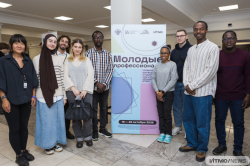
How can one digitize a manuscript that is hundreds of years old or convert carbon dioxide (CO₂) into a raw material to produce polymers? These are the problems young scientists are soling at ITMO. Their recent developments were showcased at the exhibition held as part of the 5th International Conference Young Professionals. Here are the highlights.
Researchers from ITMO and the Far Eastern Branch of the Russian Academy of Sciences have developed a compact perovskite laser that can control the rotation of vortex light and the direction of its radiation. Each wave beam turns into a data transmission channel that can be used in sensorics, AI, and quantum technologies. The results of the study are published in Nano Letters.
Why does a biologist need a laser, and a physicist – a living cell? Ask Dmitry Zuev, a PhD in physics and mathematics, senior researcher at ITMO’s Faculty of Physics, and the head of the Interdisciplinary Technologies Center (ITC) “Bridge.” At the center, 40 specialists – from school students to postdocs – develop anti-counterfeiting labels, drug delivery systems, and nanophotonic sensors for medical diagnostics. In this interview, Dmitry speaks about his professional path, why researchers need pitch sessions, and how to turn a school student into a first author in Nature Communications.
Researchers have uncovered that the spin of light can develop patterns like those of a spinning top: the spin vector moves along the surface of an inverted cone. Previously, this dynamic was thought to appear exclusively in particles with a magnetic momentum and not in photons. The discovery can potentially find applications in optical spintronics – a field in which information is transferred and processed using the spin of light instead of an electron as in traditional spintronics. The results of this RSF-supported study were published and featured as an Editors’ Suggestion in Physical Review B.
Content © 1993–2026 ITMO University
Development © 2014 ITMO University
General regulations of
Information Use